Every charging point, tariff and session in one portal.
The Obelisk Charging Points Management System runs your network end to end: locations, charging points, sessions, users, tariffs, invoices and roaming — whatever hardware is bolted to the wall.
One portal for your whole charging network.
CPMS is the control layer over your charging points. It onboards them over OCPP, keeps their state live, prices every session, and produces the invoice and settlement records afterwards.
Site owners, fleet and network operators, and property managers running more than a handful of charging points — usually across several vendors and several locations.
Configure a charging point, price it, watch it live and shut it down remotely, all from the same dashboard instead of a vendor’s portal.
Charging revenue depends on uptime and correct pricing. Both are operational problems, and both need one system that sees every point.
What operators run from CPMS.
Locations and charging points
Group charging points by site, connector type and power class. Configure AC and DC in the same location record.
Live monitoring
Availability, charging, preparing, unavailable — per charging point, per connector, with the last error code kept in view.
Remote control
Change a charging point’s configuration, start and stop a session, or make it inoperative, without a site visit.
Sessions
Every session with energy, duration, cost, tariff applied and the user or RFID token that started it.
Tariffs and pricing
Per-kWh, per-minute, session fees, idle fees, time windows and price per energy source. Different prices for the public, tenants and staff.
Invoicing and settlement
Automatic invoices per user group and settlement reports per site owner, in the currencies you operate in.
Spreadsheet export
Export session invoices and settlement data to spreadsheets for finance teams that work outside the dashboard.
Users, groups and RFID
User groups with their own tariffs and access rules. Issue, assign and revoke RFID tokens.
Meter audit
Energy consumed per session, reconciled against the charging point’s own meter, for revenue that holds up under audit.
Load management
Serve more charging points inside the connection you have, with EMS holding the site under its limit.
What changes once CPMS is in place.
Operators come to Obelisk with three or four vendor portals and a billing spreadsheet rebuilt by hand each month. That collapses into one workflow.
Fewer dead charging points, found sooner
Faults arrive with the charging point, session and error code attached, giving the team what they need to fix it without a return trip.
One workflow across vendors
A single dashboard replaces three or four separate vendor portals, so hardware becomes a procurement decision again, not an operational constraint.
Smart charging by default
Charging point power is balanced across active sessions, against the site’s connection limit and tariff windows, without a manual override.
Room to grow
New sites and markets join the same tenancy, with roaming and settlement already wired.
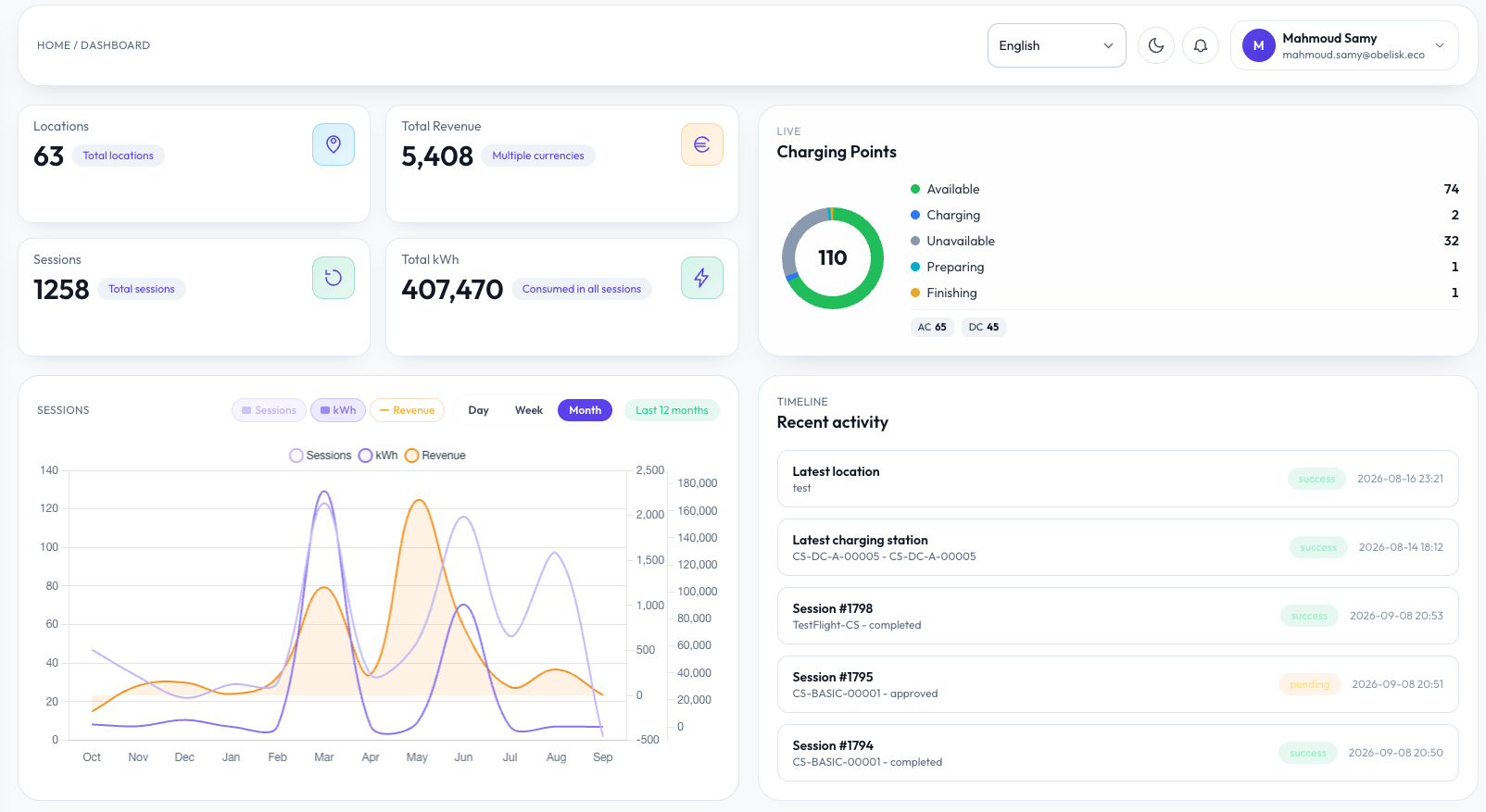
One screen for the whole network.
KPI row: locations, sessions, revenue and total kWh, each in tabular figures so month-to-month reads cleanly.
Live charging point panel: available, charging, unavailable and preparing counts, split by AC and DC.
Sessions chart: sessions, energy and revenue on one axis pair, switchable by day, week, month or last twelve months.
Activity timeline: the newest locations, stations and sessions, with their status, for a fast morning check.
AFIR-ready charging infrastructure.
Obelisk CPMS meets the Alternative Fuels Infrastructure Regulation. Ad-hoc charging without a subscription, card and contactless payment at the charging point, transparent pricing shown before the session starts, and the static and dynamic data the regulation requires — available to national access points and third-party services.
Operators run compliant sites from day one, without building the reporting themselves.
Questions operators ask first.
Any charge point that speaks OCPP 1.6J or 2.0.1 can be onboarded. The supported models list is maintained per vendor and firmware version, and we test new models on request before you commit to a purchase.
Yes. Points are re-pointed to Obelisk by changing the backend URL in the charger configuration. Historical session data can be imported so reporting continuity is kept where the previous system allows an export.
Tariffs are assigned to user groups, so the public, tenants, staff and fleet drivers can charge on the same point at different prices, including free charging for a defined group.
Both are supported. Obelisk can issue invoices and settlement reports directly, or produce structured exports for the finance system you already use.
Roaming connections let external drivers charge on your network and your drivers charge elsewhere, with the session records and settlement statements kept on the same platform.
Role permissions are scoped by site and team, so a property manager sees their building, a support agent sees sessions and commands, and finance sees invoices.
Bring your hardware list. We will show you the dashboard running it.
A CPMS walkthrough takes thirty minutes and covers onboarding, tariffs and settlement against your own sites.