Turn EV charging into an intelligent energy service.
Help your customers charge smarter, use more solar energy, optimise battery storage, and respond to dynamic energy prices — all through one integration with Obelisk.
One integration. Endless energy possibilities.
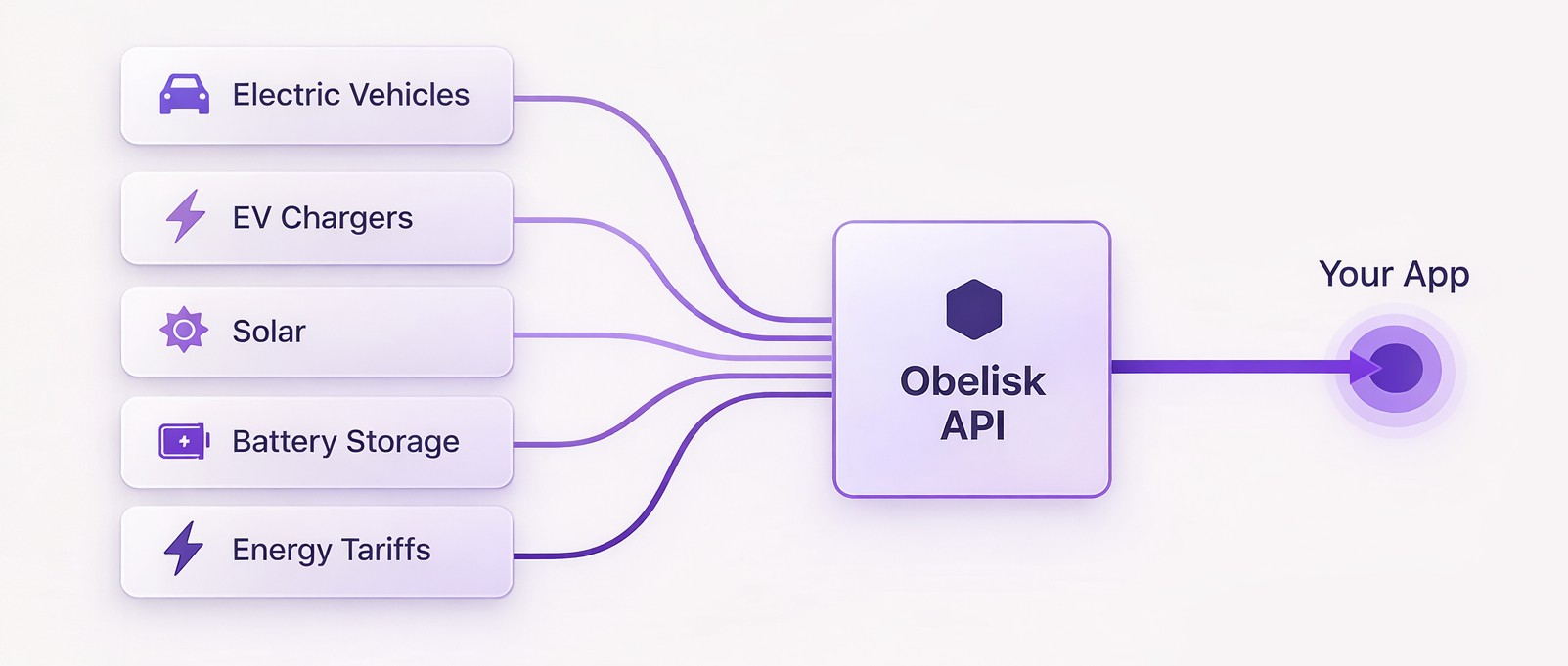
Obelisk connects EV charging infrastructure, solar energy, battery storage and dynamic energy tariffs through a unified API platform.
OEMs and automotive brands, energy providers and utilities, and fleet operators who want to build energy services on top of EV charging rather than build the connections themselves.
EV chargers, solar inverters, batteries and tariff feeds each speak their own protocol. Integrating them one at a time is what usually stops an energy product from shipping.
This enables companies to build intelligent energy services that optimise charging costs, increase renewable energy usage, and respond to real-time energy market signals — through one integration with Obelisk.
What you can build with the Obelisk API.
Seamless device integration
Connect smart energy devices from multiple manufacturers through a single unified API — meters, plugs, relays, and more.
Boost consumer engagement
Give customers real-time energy insights and control. Increase satisfaction, reduce churn, and build loyalty through transparency.
Optimise and monetise load
Aggregate flexible load across your customer base, balance grid participation, and unlock new revenue streams from demand response.
API reference
Full documentation for every endpoint — vehicles, chargers, solar, storage and tariffs — so your team can integrate without waiting on us.
One unified API to enable smart charging and optimise every session.
Day-ahead hourly energy price across 24 hours, plotted in 15-minute steps. An 11 kW vehicle needs four hours.
What companies can do once they connect.
When EV charging is connected with solar generation, battery storage and dynamic energy prices, entirely new services become possible.
Charge vehicles when electricity is cheapest
Sessions shift into low-tariff windows automatically, without the driver changing their routine.
Maximise the use of solar energy
Charging follows on-site production so self-generated power is used before grid power is bought.
Reduce grid load during peak hours
Demand is smoothed across the day instead of spiking when everyone plugs in at once.
Offer intelligent energy tariffs
Price charging against real tariff data instead of a flat rate that ignores when energy is cheap.
Optimise fleet charging automatically
A fleet’s vehicles charge on a schedule built from departure times and energy cost, not arrival order.
Turn energy intelligence into customer value.
Obelisk provides the digital infrastructure that enables it.

Questions integration teams ask first.
Electric vehicles, EV chargers, solar production, battery storage and energy tariffs — each through its own endpoint, unified under one integration.
No. Most teams start with EV chargers and add solar, storage or tariff data as their product needs it. Each endpoint ships with an API reference so it can be integrated independently.
Yes. Every capability in the platform has a documented API reference, available as part of the technical walkthrough.
OEMs building energy features into a vehicle or app, energy providers building customer-facing tariff and engagement products, and fleets optimising their own charging.
Dynamic tariff and market signal data is normalised through the same API as the charging and energy device data, so your app reads one format regardless of the source.
Yes. The API is the integration layer — what you build with it, and how it is branded, is entirely up to your team.
Tell us what you want to connect.
We will walk through the API against your own vehicles, chargers and energy sources.